
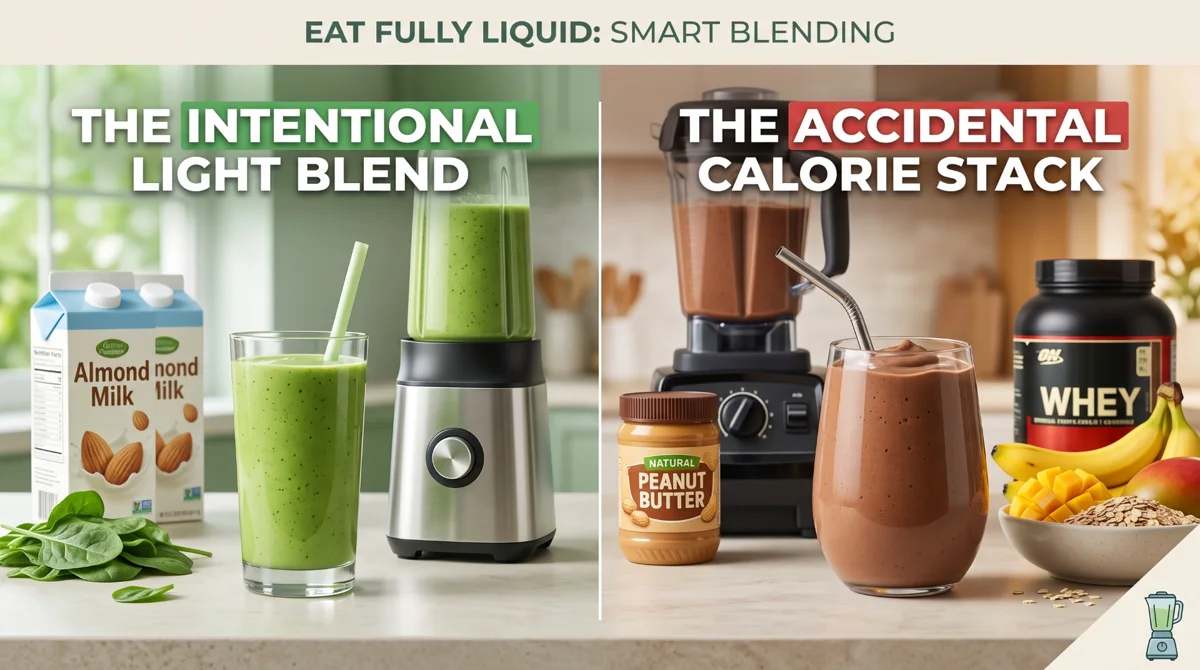
Just Because It’s Liquid Doesn’t Make It Low Calorie
The science of ingredient stacking, the smoothie calorie trap, and how to build a blend that actually fits your goals.
One of the biggest surprises when transitioning to a liquid or soft-food diet is discovering that what looks like a light, refreshing drink can easily pack more calories than a full sit-down dinner.
You toss a few wholesome ingredients into a blender cup, hit pulse, and pour what looks like a sensible 16-ounce snack. But when you do the math, that single glass can quietly sit between 700 and 900+ calories.
Whether you’re on a liquid diet for medical reasons, recovery, dental procedures, or wellness, understanding how calories accumulate in a glass is essential. It comes down to a phenomenon called ingredient stacking.
Why it happens
What is ingredient stacking?
When preparing whole meals, our eyes naturally gauge volume. Put a chicken breast, two scoops of peanut butter, Greek yogurt, a banana, berries, oats, and two cups of milk on a plate and it looks like a feast. Blended together, that entire spread can collapse into one tumbler.
Ingredient stacking happens when several calorie- and nutrient-dense ingredients are layered without accounting for how quickly their calories compound:
- Liquid base: Oat milk, whole milk, or fruit juice can add 120–160 calories before solids.
- Primary protein: A standard scoop of whey or plant protein powder adds about 120–150 calories.
- Secondary protein and fats: Two tablespoons of peanut or almond butter can add another 190–210 calories.
- Functional boosters: Collagen peptides and Greek yogurt may add roughly 130 calories together.
- Carbs, fiber, and seeds: Banana, mixed fruit, and chia or flax can add another 200–250 calories.
Individually, each item can be nutrient-dense. Stacked together in one glass, the energy density can rise quickly.
Side-by-side
The intentional 300 vs. the accidental 800
Two familiar smoothie builds show how quickly stacking happens. These are estimates; brands, serving sizes, and preparation change the totals.
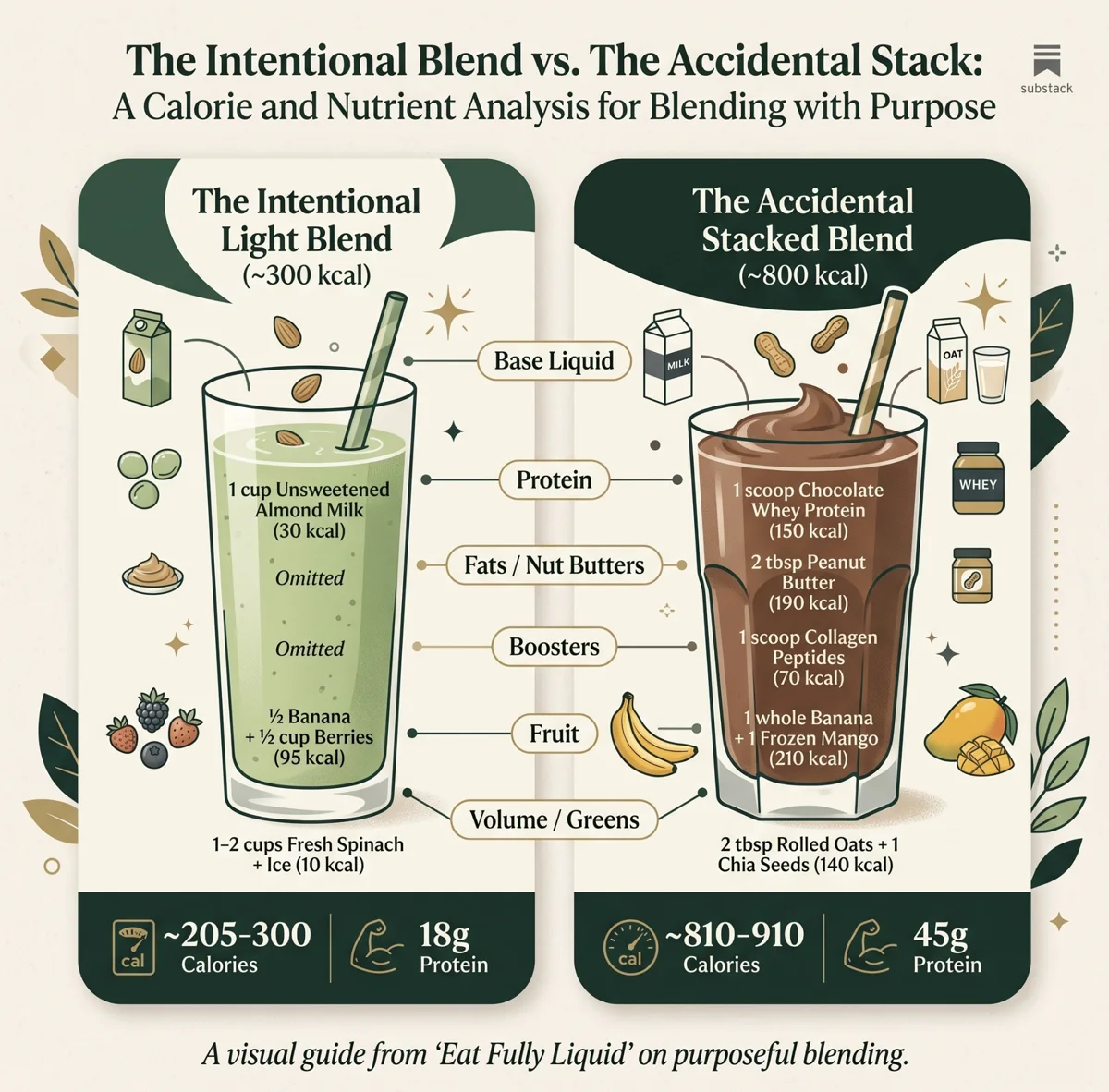
| Component | Intentional light blend | Accidental stacked blend |
|---|---|---|
| Base liquid | 1 cup unsweetened almond milk (30 kcal) | 1 cup whole milk or sweetened oat milk (150 kcal) |
| Protein | 1 scoop collagen peptides (70 kcal) | 1 scoop chocolate whey protein (150 kcal) |
| Fats / nut butter | Omitted (0 kcal) | 2 tbsp peanut butter (190 kcal) |
| Boosters | Omitted (0 kcal) | 1 scoop collagen peptides (70 kcal) |
| Fruit | ½ banana + ½ cup berries (95 kcal) | 1 whole banana + 1 cup frozen mango (210 kcal) |
| Volume / greens | 1–2 cups fresh spinach + ice (10 kcal) | 2 tbsp rolled oats + 1 tbsp chia seeds (140 kcal) |
| Estimated total | ~205–300 calories · 18g protein | ~810–910 calories · 45g protein |
Neither approach is automatically wrong. A high-calorie blend can be useful when a care team recommends calorie-dense nutrition for recovery or weight maintenance. If your goal is a lighter meal or hydration, unmeasured stacking can work against it.
Fullness cues
Why liquid calories may feel different
Liquids require less chewing and mechanical breakdown than whole foods. Drinking quickly may also give your body less time to register the meal, and a blended drink’s compact volume can make its ingredients easy to underestimate. Individual fullness and gastric emptying vary, especially after surgery, so follow your care team’s pacing and portion guidance.
Four practical rules
Build a blend that matches your goal
1. Pick one primary protein anchor
Avoid combining protein powder, nut butter, Greek yogurt, and collagen unless you intentionally need a calorie-dense shake. Pick one main source and count every additional protein or fat as a separate ingredient.
2. Choose the liquid base intentionally
When extra calories are not the goal, compare labels for unsweetened milk alternatives, chilled tea, or water and ice. Choose only liquids allowed by your medical plan.
3. Lean on pre-portioned options
When convenience matters, pre-portioned cups such as Daily Harvest smoothie cups can make ingredient ratios and nutrition easier to review before blending. Check every label and confirm the finished texture fits your current diet stage.
4. Use the right tool for the job
- Personal blender: A compact option such as the nutribullet Ultra Personal Blender can naturally limit batch size.
- High-powered blender: A Vitamix 5200 Blender can process fibrous greens and frozen ingredients more thoroughly. Blending does not automatically make food safe for dysphagia.
- Shaker bottle: For powder and an approved liquid, a BlenderBottle Classic V2 can keep preparation simple without extra ingredients.
The takeaway
Liquid nutrition is versatile. The goal is not to cut out ingredients you enjoy; it is to understand what each addition contributes and stack them intentionally for the plan you and your care team chose.
Affiliate disclosure: We may earn a commission if you buy through product or deal links, at no extra cost to you. As an Amazon Associate, EatFullyLiquid earns from qualifying purchases. Partnerships do not determine which products are listed. Prices and availability are set by the retailer. Product information is not medical advice.